On this page
IGCSE Maths common mistakes on Cambridge 0580 are mostly habits, not gaps in knowledge. The biggest are rounding too early, ignoring the accuracy a question asks for, and not showing working. The March and June 2025 examiner reports also flag bounds, vectors, functions, transformations, standard form and angle reasons. Each one below comes with an original example and a fix you can practise this week.
The 0580 papers for 2025 to 2027
The 0580 syllabus changed for exams from 2025. The current syllabus covers exams in 2025, 2026 and 2027, in the June and November series (plus March in India). Each tier now has one non-calculator paper and one calculator paper, worth 50% each.
| Paper | Tier | Calculator | Time | Marks |
|---|---|---|---|---|
| Paper 1 | Core | Not allowed | 1 hour 30 minutes | 80 |
| Paper 3 | Core | Required | 1 hour 30 minutes | 80 |
| Paper 2 | Extended | Not allowed | 2 hours | 100 |
| Paper 4 | Extended | Required | 2 hours | 100 |
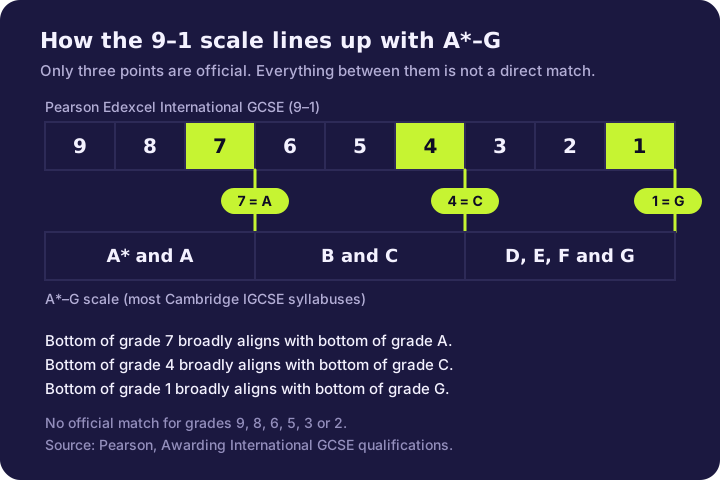
Core students can get grades C to G. Extended students can get grades A* to E, so if you want an A*, you sit Papers 2 and 4. Cambridge’s getting-ready factsheet confirms that every paper has a formula list at the front, but the syllabus warns that not every formula you need is on it.
If you are still choosing a board, our comparison of Cambridge and Edexcel IGCSE explains how the two maths exams differ.
How 0580 marks are awarded
Knowing the mark types tells you exactly what each mistake costs. Cambridge mark schemes use these labels:
| Mark | What it is for | What loses it |
|---|---|---|
| M (method) | A correct method, even if the answer is wrong | No working, or a method the examiner cannot follow |
| A (accuracy) | A correct answer after a correct method | Early rounding, wrong accuracy, arithmetic slips |
| B (independent) | A correct result that does not depend on method | A wrong final value, or the right value in the wrong form |
| FT (follow through) | Correct work that uses your own earlier wrong answer | Working that is missing, so there is nothing to follow |
An A mark usually depends on the M mark before it. So a lost method mark can take the accuracy mark with it.
The accuracy rules Cambridge states
These rules are in the syllabus, and the mark schemes follow them.
- Give non-exact answers to 3 significant figures, unless the question says otherwise.
- Give angles in degrees to 1 decimal place, unless the question says otherwise.
- Do not round until the final answer. If you reuse an answer in a later part, use the unrounded value.
- Use the π button on your calculator, or 3.142.
- If an answer is exact to 4 or 5 significant figures, do not round it.
- Give answers in simplest form, and never mix fractions and decimals in one answer.
- An exact value may need to be in terms of π or in surd form.
The 12 IGCSE Maths common mistakes and how to fix them
Mistakes 1 to 10 are each flagged in the March 2025 or June 2025 Cambridge 0580 examiner reports. Mistakes 11 and 12 come from a Cambridge Assessment study of common errors, which looked at 0580 examiner reports from 2009 to 2012, and from the June 2025 report. All the examples are our own.
1. Rounding in the middle of a calculation
Premature rounding means rounding a number partway through a calculation and then using the rounded value in the next step. The small error grows with each step, so the final answer can fall outside the range the mark scheme accepts. The 0580 syllabus tells candidates to avoid rounding until the final answer if they want the accuracy marks.
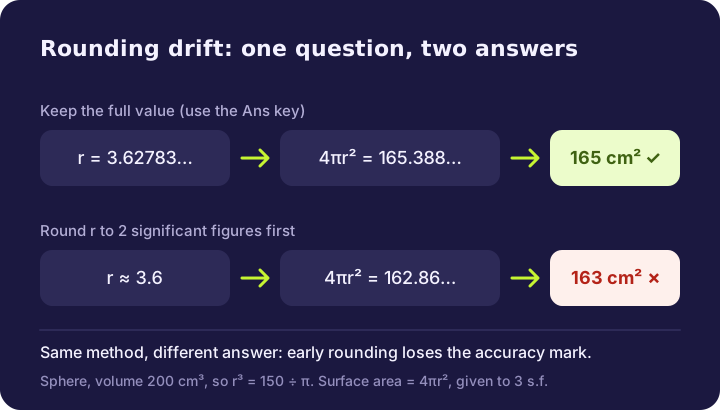
Example: A sphere has volume 200 cm³. Find its surface area.
Weak answer · loses the accuracy mark
r³ = 150 ÷ π, so r = 3.6. Surface area = 4π × 3.6² = 163 cm²
Full-mark answer
r³ = 150 ÷ π, so r = 3.62783… (kept on the calculator). Surface area = 4πr² = 165.388… = 165 cm²
Rounding r to 3.63 does not save you either: it gives 166 cm². The March 2025 report notes many candidates losing accuracy marks this way.
Fix: Keep the full value on your calculator (use Ans or the memory key). Write at least 4 or 5 significant figures in your working, then round once at the end.
2. Ignoring the accuracy the question asks for
What goes wrong: The question says “to the nearest dollar” or “to 1 decimal place”, and you give 3 s.f. out of habit. Or you cut an angle short. The March 2025 report describes students losing the accuracy mark on an angle answer that was not correct to the required decimal place.
Example: sin x = 0.4, so x = 23.578…° = 23.6°. Writing 24°, or truncating to 23.5°, loses the accuracy mark. Also, 2.5 × 4.37 = 10.925 is exact, so write 10.925, not 10.9.
Fix: Underline the accuracy instruction. Write the longer value first (for example 23.578…), then the rounded one, so the examiner can see you had the right number.
3. Not showing working
What goes wrong: You do a step in your head and write only the answer. If it is wrong, there is nothing to give method marks for. The June 2025 report for Paper 2 is clear: “Without working shown, they are usually unable to score any method marks.”
Example: A jacket costs $64 after a 20% discount. Find the original price.
Weak answer · 0 marks
$76.80
Full-mark answer
80% of the price = $64, so the price = 64 ÷ 0.8 = $80
The weak answer used 64 × 1.2, a common wrong method. With “64 ÷ 0.8” written down, a slip in the final division could still earn the method mark.
Fix: Write the formula, then the substitution, then the answer. On “show that” questions, show every step and never start from the answer you are asked to prove.
4. Using 3.14 when the answer should be in terms of π
What goes wrong: On the non-calculator papers, many answers must stay in terms of π. The June 2025 report advises against using 3.14 or 22/7 and noted students writing 45/360 as 8 instead of 1/8.
Example: Find the area of a sector with radius 6 cm and angle 45°, in terms of π.
- 45/360 = 1/8
- Area = 1/8 × π × 6² = 9π/2 cm² (or 4.5π cm²)
Fix: On Papers 1 and 2, treat π like a letter in algebra. Simplify the number in front and leave π in the answer.
5. Pairing the wrong bounds (Extended)
What goes wrong: You find each upper and lower bound correctly, then combine the wrong pair. The March 2025 report says many incorrect answers used both lower bounds. Using both upper bounds is just as wrong.
Example: A runner covers 120 m (to the nearest 10 m) in 15 s (to the nearest second). Find the upper bound of the speed.
- 115 ≤ distance < 125 and 14.5 ≤ time < 15.5
- Upper bound = 125 ÷ 14.5 = 8.62 m/s (3 s.f.)
- 125 ÷ 15.5 = 8.06 m/s uses the upper bound of both, which is not the maximum.
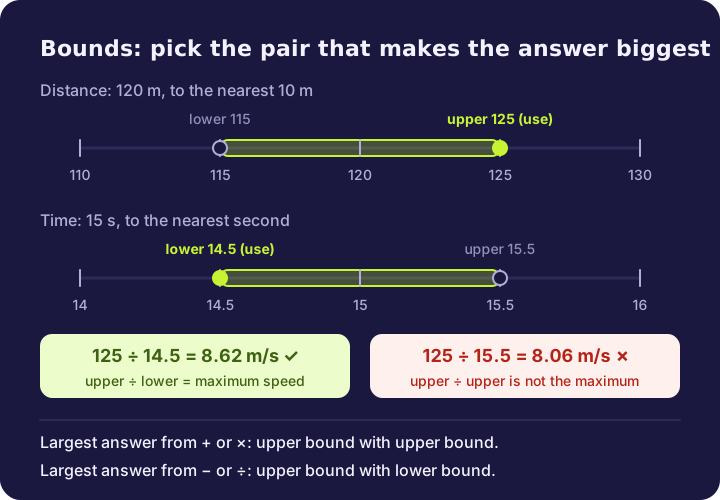
Fix: For each value, ask: “To make the answer as large as possible, do I want this big or small?” Dividing by the smallest time gives the largest speed. Core students only need the bounds of a measurement, not of a calculation.
6. Vector direction and route errors (Extended)
What goes wrong: You write a − b when the route needs b − a, or you mix up a position vector with a route. The 2025 reports note sign errors from ignoring direction, and answers that were not vectors at all.
Example: OA = a and OB = b. M is the midpoint of AB. Find the position vector of M.
- AB = AO + OB = −a + b = b − a
- OM = OA + ½AB = a + ½(b − a) = ½a + ½b
Fix: Write the route first (OM = OA + AM), then fill in each piece. A position vector always starts from O.
7. Confusing f⁻¹(x) with 1/f(x) (Extended)
What goes wrong: The −1 looks like a power, so students write a reciprocal. Both 2025 reports mention this. With composite functions, the June 2025 report notes students multiplying the two functions instead of putting one inside the other.
Example: f(x) = 3x − 5 and g(x) = x².
- f⁻¹(x) = (x + 5)/3, not 1/(3x − 5)
- fg(x) = f(g(x)), so apply g first: fg(x) = 3x² − 5
- gf(x) = g(f(x)), so apply f first: gf(x) = (3x − 5)²
Fix: Read fg(x) from right to left. Check an inverse with a number: f(2) = 1, so f⁻¹(1) must equal 2.
8. Describing a transformation incompletely
What goes wrong: You leave out a detail, use words like “moved” or “turned”, or describe two transformations when the question asks for one. The June 2025 report says adding a translation to a single-transformation answer automatically scored zero. The March 2025 report adds that giving the centre as a column vector is incorrect.
| Transformation | You must give |
|---|---|
| Translation | “Translation” and a column vector |
| Reflection | “Reflection” and the mirror line, e.g. y = −x |
| Rotation | “Rotation”, angle, direction and centre, e.g. 90° anticlockwise, centre (1, 2) |
| Enlargement | “Enlargement”, scale factor and centre, e.g. scale factor −2, centre (0, 3) |
Fix: Give the centre as coordinates, not as a vector. Negative scale factors are Extended only.
9. Standard form slips without a calculator
What goes wrong: The June 2025 report lists answers with more than one digit before the decimal point, powers that changed sign, and place-value errors when adding.
Example 1: (4 × 10⁵) × (6 × 10³) = 24 × 10⁸ = 2.4 × 10⁹. “24 × 10⁸” is not standard form.
Example 2: 3.2 × 10⁴ + 5 × 10³ = 32 000 + 5000 = 3.7 × 10⁴, not 8.2 × 10⁷.
Fix: Multiply the numbers and the powers separately, then adjust so the first part is between 1 and 10. To add, change both to the same power of 10 first. Core students only calculate with standard form on Paper 3; Extended students can meet it on Paper 2.
10. Vague angle reasons
What goes wrong: When asked for reasons, students write “parallel lines” or “because of the circle”. The June 2025 report advises using standard wording directly from the syllabus.
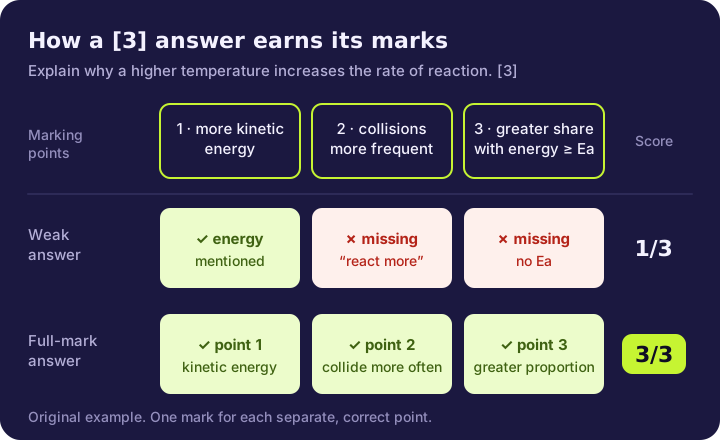
Weak answer · reason mark lost
y = 64° because of parallel lines.
Full-mark answer
y = 64° because alternate angles are equal.
Standard phrases to learn:
- Angles on a straight line add up to 180°.
- Corresponding angles are equal.
- The angle in a semicircle is 90°.
- Opposite angles of a cyclic quadrilateral add up to 180°.
Fix: Learn the exact wording and give one reason per step. Say “angles”, not “sides”: the March 2025 report noted students writing that opposite sides of a cyclic quadrilateral add up to 180°.
11. Calculator input errors
What goes wrong: The Cambridge Assessment study found Extended candidates squaring negative numbers without brackets, and Core candidates entering calculations in the wrong order. The calculator does exactly what you type, not what you mean.
Example:
- Typing −3² gives −9. Typing (−3)² gives 9.
- To work out (5 + 7) ÷ (2 × 3), typing 5 + 7 ÷ 2 × 3 gives 15.5. The correct answer is 2.
Fix: Put brackets around every negative number you square and around every whole numerator and denominator. Then check with a rough estimate: if the answer is wildly different, re-enter it.
12. Answering a different question from the one asked
What goes wrong: The June 2025 report flags money misread in a subtraction question, clock-time errors, and answers not given in the form asked. Misreading also includes missing units and giving a combination of transformations when one was required.
Example: A bus leaves at 2245 and the journey takes 3 hours 40 minutes. When does it arrive?
- 2245 + 3 h = 0145 (the next day), then + 40 min = 0225
- A common error is treating time as a decimal: 22.45 + 3.40 = 25.85, which is not a time. The real answer is 02:25 the next day.
Fix: Before writing the final answer, check three things: the form (24-hour clock, fraction, π), the units, and the accuracy.
Two-minute check for every answer: Did I round only at the end? Is it to the accuracy asked? Is my working visible? Does the answer have units and the right form?
Which mistakes cost most on each paper
| Mistake | Where it usually costs marks | Tier |
|---|---|---|
| Early rounding, wrong accuracy | Calculator papers (3 and 4) | Both |
| Calculator input errors | Calculator papers (3 and 4) | Both |
| π answers, fractions, negative numbers | Non-calculator papers (1 and 2) | Both |
| Standard form | Paper 3 for Core; Papers 2 and 4 for Extended | Both |
| Bounds of calculations | Any Extended paper | Extended |
| Vectors, functions | Any Extended paper | Extended |
| Missing working, vague reasons | Every paper | Both |
A practice routine that fixes these mistakes
For a full plan, see our guide on how to use IGCSE past papers with a 6-week plan. Here is a short weekly routine:
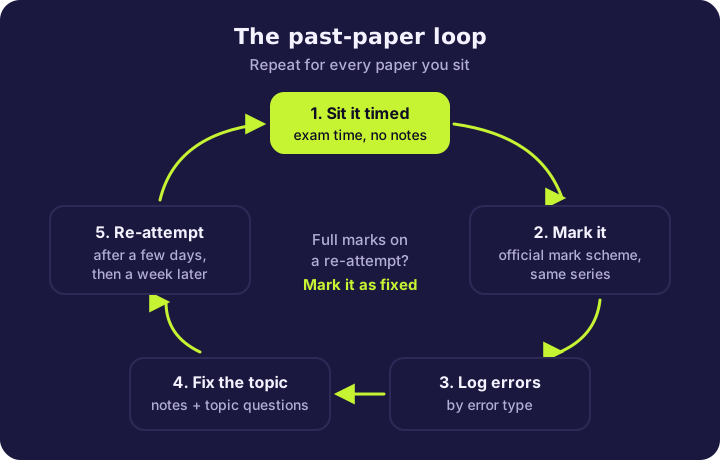
- Do one timed paper a week. Alternate between your non-calculator and calculator paper, using the real time limit.
- Mark it strictly with the mark scheme. Note whether each lost mark was an M, A or B mark.
- Tag every lost mark with one of the twelve mistakes above.
- Find your top two tags and spend two short sessions that week only on them.
- Do ten minutes of non-calculator arithmetic daily. The June 2025 report flagged weaknesses with decimals, fractions, percentages and the order of operations on Paper 1.
- Read the examiner report for each paper you practise. Ask your teacher, or start from Cambridge’s 0580 past papers page.
Do not chase one year’s grade boundary. Raw marks for each grade change every series. Our guide to IGCSE grade boundaries explains why.
The same habits help in science too. Our guide to answering longer Chemistry 0620 questions uses the same “show the examiner your method” idea.
Key points
- One non-calculator and one calculator paper per tier, 50% each, for 2025 to 2027.
- 3 significant figures and angles to 1 decimal place, unless told otherwise.
- Never round until the final answer.
- Show working: without it, a wrong answer scores no method marks.
- Bounds: for the largest quotient, divide the upper bound by the lower bound.
- Vectors: write the route first; position vectors start from O.
- f⁻¹ is an inverse, not a reciprocal; fg means g first.
- Single transformations need every detail, and only one transformation.
- Angle reasons need full standard wording.
- Brackets on the calculator, and a final check of form, units and accuracy.
Frequently asked questions
What are the most common mistakes in IGCSE Maths?
On Cambridge 0580, the mistakes examiners mention most are habits rather than gaps in knowledge: rounding in the middle of a calculation, ignoring the accuracy a question asks for, and not showing working. The 2025 examiner reports also flag errors with bounds, π answers, vectors, inverse functions, transformations, standard form and angle reasons. Most can be fixed with a short checking routine.
Do you lose marks for not showing working in IGCSE Maths?
Often, yes. The 0580 syllabus says that when a question asks you to show your working, you cannot get full marks without it. If your answer is wrong and there is no working, the examiner has nothing to award method marks for, so you score zero. On non-calculator papers and "show that" questions, full working is essential even when your answer is right.
How many significant figures should I give in IGCSE Maths?
Unless the question says otherwise, give non-exact answers to 3 significant figures and angles in degrees to 1 decimal place. If an answer is exact to 4 or 5 significant figures, such as 10.925, do not round it. Always keep more figures in your working and round only once, at the very end.
Are mistakes different on the calculator and non-calculator papers?
Yes. On the non-calculator papers (1 and 2), marks are lost on fractions, negative numbers, standard form and answers that should stay in terms of π. On the calculator papers (3 and 4), the big losses are early rounding, wrong accuracy and calculator input errors such as squaring a negative number without brackets.
Which 0580 papers do I need to sit to get an A*?
You need the Extended tier: Paper 2 (non-calculator) and Paper 4 (calculator), each 2 hours and 100 marks. Extended candidates can get grades A* to E. The Core tier, Papers 1 and 3, only allows grades C to G, so a Core candidate cannot get an A or A* however well they do.
About this guide
Written by the Revizona team for IGCSE students in Indonesia. Exam facts are checked against the official Cambridge International and Pearson Edexcel documents for the current syllabus years, and the guide is updated when they change.