On this page
- What is IGCSE Chemistry Paper 4?
- How the 0620 papers fit together
- What a “long answer” means in 0620
- The command words that matter most
- Exact wording that earns marks
- How to answer calculations and equations
- Worked example 1: an “explain” question on rate
- Worked example 2: a mole calculation
- Worked example 3: a “describe a test” question
- Weaknesses Cambridge keeps reporting
- How many marks you need on Paper 4
- A step-by-step method for every long answer
- A practice routine that works
- Key points
To answer long questions in IGCSE Chemistry Paper 4, count the marks in brackets, read the command word, and give one separate, correct chemical point for each mark. “Explain” needs a reason, calculations need every step and a unit, and tests need the exact reagent and observation. This guide shows you how, with three worked examples for Cambridge 0620.
It is written for students who know the content but still lose marks on the longer written parts of Paper 4 (Extended) or Paper 3 (Core). Everything here is checked against the Cambridge IGCSE Chemistry 0620 syllabus for 2026, 2027 and 2028.
What is IGCSE Chemistry Paper 4?
IGCSE Chemistry Paper 4 is the Extended theory paper of Cambridge syllabus 0620. It lasts 1 hour 15 minutes, is out of 80 marks and is worth 50% of the final grade. All questions are compulsory short-answer and structured questions on the Core and Supplement content. Only Extended candidates (grades A* to G available) take it.
Your exam paper will show a variant number, such as 41, 42 or 43. The variant changes the questions, not the format. Core candidates take Paper 3 instead, which has the same timing and marks but tests Core content only, with grades C to G available.
How the 0620 papers fit together
Every 0620 candidate takes three papers: one multiple-choice paper, one theory paper and one practical paper.
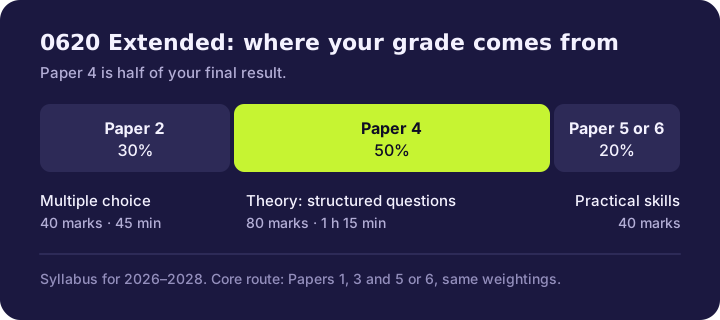
| Paper | Who takes it | Duration | Marks | Weighting |
|---|---|---|---|---|
| Paper 1 Multiple Choice (Core) | Core | 45 minutes | 40 | 30% |
| Paper 2 Multiple Choice (Extended) | Extended | 45 minutes | 40 | 30% |
| Paper 3 Theory (Core) | Core | 1 hour 15 minutes | 80 | 50% |
| Paper 4 Theory (Extended) | Extended | 1 hour 15 minutes | 80 | 50% |
| Paper 5 Practical Test | Core or Extended | 1 hour 15 minutes | 40 | 20% |
| Paper 6 Alternative to Practical | Core or Extended | 1 hour | 40 | 20% |
Source: the 0620 syllabus for 2026–2028. The syllabus for 2029 keeps the same six papers, timings and weightings, so the technique in this guide stays useful.
Exams run in the June and November series (there is also a March series, for schools in India only). Paper 4 alone is half of your result, so long-answer technique is worth practising on its own.
Timing tip: 75 minutes for 80 marks is just under one minute per mark. A [3] part deserves about three minutes. If you spend six minutes on one part, you are taking time from a later question.
What a “long answer” means in 0620
You will not write essays. Each question is split into parts like (a) and (b)(i), and each part shows its marks in brackets, such as [3]. A long answer in 0620 is a part worth several marks, where you need several separate correct points.
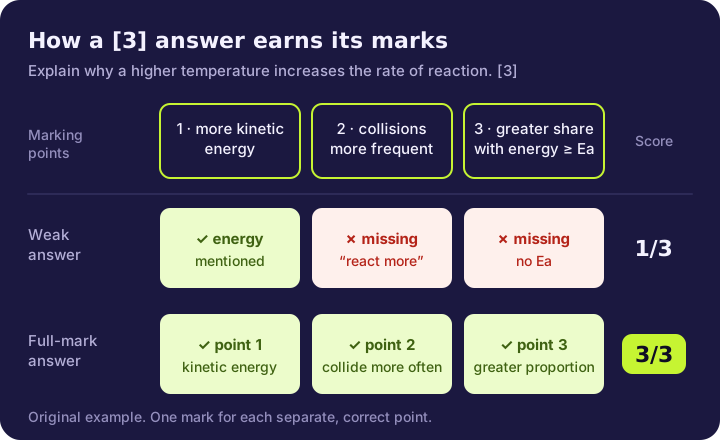
Think of each mark as a box the examiner wants to tick. In general, a [3] part needs three separate, correct points, so plan that many before you write. The diagram at the top of this page shows how this works for a rate question.
- Be specific. “It goes faster” rarely earns a mark. Say what goes faster and why.
- Name things, don’t point at them. Write “the particles” or “the acid”, not “it” or “they”.
- One answer only. If you give two answers and one is wrong, the wrong one can cancel the right one.
- Name or formula? If the question asks for a name, give the name, not a formula.
The command words that matter most
The command word tells you what kind of answer gets the marks. These meanings come from the 0620 syllabus, in simpler words.
| Command word | What Cambridge wants |
|---|---|
| State | Say it clearly and briefly. No reason needed. |
| Give | Produce an answer from the information given or from memory. |
| Identify | Name, select or recognise something. |
| Define | Give a precise meaning. |
| Describe | State the points of a topic, or give its main features. |
| Explain | Give reasons. Make the relationship between things clear. Say why and/or how. |
| Suggest | Apply what you know to a new situation where more than one answer could be right. |
| Calculate | Work out an answer from the facts and figures given. |
| Deduce | Reach a conclusion from the information available. |
| Predict | Say what may happen, based on the information available. |
The two words that cost students the most are describe and explain. “Describe” asks what happens. “Explain” asks why or how it happens. If a question says explain and you only describe, you have answered half the question.
In the June 2025 examiner report for Papers 32 and 33, Cambridge wrote that candidates “struggled to give detailed answers to questions with the command words ‘deduce’ or ‘explain’”. Detail is what earns the marks.
Exact wording that earns marks
Mark schemes accept equivalent wording, but vague wording rarely matches a marking point. These phrases follow the syllabus definitions and are worth learning word for word.
| Topic | Words to use |
|---|---|
| Activation energy | The minimum energy that colliding particles must have to react |
| Rate and temperature | Particles have more kinetic energy; collide more frequently; more collisions have energy ≥ activation energy |
| Rate and concentration | More particles per unit volume, so more frequent collisions |
| Catalyst | Lowers the activation energy; is not used up |
| Halide ions | Acidify with dilute nitric acid, add aqueous silver nitrate: chloride white, bromide cream, iodide yellow precipitate |
| Volumes | Use dm³, not litres; 1 dm³ = 1000 cm³ |
Build your own version for your hardest topics, and add to it whenever a mark scheme uses a phrase you missed.
How to answer calculations and equations
Calculations
- Show your working. If your final answer is wrong but your method is right, you can still get credit. The June 2024 report for Paper 42 noted that error-carried-forward credit was often given in multi-step calculations.
- Units. Give a unit with every final answer unless the question already shows it. Watch cm³ and dm³: 1 dm³ = 1000 cm³.
- Molar gas volume. One mole of any gas is 24 dm³ (24 000 cm³) at room temperature and pressure. Multiplying by 24 when the answer must be in cm³ was a common error in recent reports.
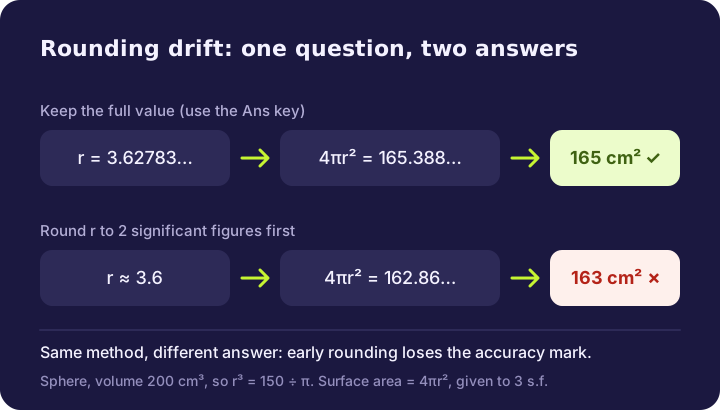
- Significant figures. The syllabus says a calculated answer should have the same number of significant figures as the least precise data you used. Round only at the end.
- Use decimals, not fractions. The June 2025 report warned against fractions as final answers. Calculators are allowed in all parts of the exam.
Equations
The syllabus expects you to write balanced symbol equations, and to include state symbols (s), (l), (g) and (aq) when asked. Extended candidates also need ionic equations. Check balance and state symbols before you move on.
The June 2024 report for Paper 41 said state symbols were often left out. It also noted that formulae of compounds should never show charges: write NaCl, not Na⁺Cl⁻.
Worked example 1: an “explain” question on rate
This is an original question in the 0620 style. The mark allocations are our own illustration, not an official scheme.
Magnesium ribbon reacts with dilute hydrochloric acid. The experiment is repeated at a higher temperature. All other conditions stay the same. Explain, in terms of particles, why the rate of reaction increases. [3]
Weak answer · 1/3
“The particles have more energy so they move faster and react more. The reaction is quicker because it is hotter.”
Full-mark answer · 3/3
“At a higher temperature, the particles have more kinetic energy and move faster. So they collide more frequently. A greater proportion of the collisions have energy equal to or greater than the activation energy, so there are more successful collisions per second.”
Why the second answer scores: It makes three separate points that link to collision theory: (1) more kinetic energy, (2) more frequent collisions, (3) a greater proportion of particles or collisions with at least the activation energy. The weak answer says “react more” and “quicker” but never mentions collisions or activation energy. It is a description, not an explanation.
Watch point 3. The June 2025 report for Paper 42 said a common error was to write only that the particles have energy above the activation energy. Some particles already had that energy at the lower temperature. The key idea is that a greater proportion do now.
Worked example 2: a mole calculation
Original question.
2.10 g of magnesium carbonate reacts completely with excess hydrochloric acid. MgCO₃(s) + 2HCl(aq) → MgCl₂(aq) + H₂O(l) + CO₂(g) Calculate the volume of carbon dioxide produced, in cm³, at room temperature and pressure. [3]
Weak answer · 1/3
“2.10 ÷ 84 = 0.025 × 24 = 0.6”
Full-mark answer · 3/3
- Mr of MgCO₃ = 24 + 12 + (3 × 16) = 84
- Moles of MgCO₃ = 2.10 ÷ 84 = 0.0250 mol
- From the equation, 1 mol MgCO₃ gives 1 mol CO₂, so moles of CO₂ = 0.0250 mol
- Volume of CO₂ = 0.0250 × 24 000 = 600 cm³
Why the second answer scores: Each step is shown, so the examiner can give method marks even if one number goes wrong. It states the mole ratio and uses 24 000 because the question asks for cm³. The weak answer used 24, which gives dm³, and had no unit, so “0.6” does not answer the question. The data has three significant figures, and so does the answer.
Worked example 3: a “describe a test” question
Original question.
A solution contains either chloride ions or iodide ions. Describe a test that shows which ion is present. Give the result for each ion. [3]
Weak answer · 0/3
“Add silver. It goes cloudy if it is chloride.”
Full-mark answer · 3/3
“Acidify the solution with dilute nitric acid, then add aqueous silver nitrate. Chloride ions give a white precipitate. Iodide ions give a yellow precipitate.”
Why the second answer scores: It names both reagents in full (dilute nitric acid, aqueous silver nitrate), gives the exact observation (precipitate, not “cloudy”), and gives the colour for both ions, because the question asks for the result for each. “Silver” on its own is a metal, not a reagent.
The syllabus provides notes for qualitative analysis in Papers 5 and 6 only. On Paper 4 you must remember the tests yourself. Examiner reports for Papers 32 and 33 in both 2024 and 2025 said tests for ions were often poorly answered. For Paper 41 in 2025, examiners reminded candidates that an observation is something you see: write “bubbles”, not “a gas is produced”.
Weaknesses Cambridge keeps reporting
From the 0620 Principal Examiner Reports for Teachers (June 2024 and June 2025):
- Vague answers, including “it” and “they” with no clear meaning.
- Missing the word “particles” in particle and rate answers (Core papers).
- Misreading the question, such as getting the direction of a rate change the wrong way round.
- Chemical tests poorly recalled, with observations guessed or missing.
- Equations unbalanced, missing state symbols, or with charges in formulae.
- Calculations using 24 instead of 24 000 for cm³, or ending with fractions.
- Confusing rate with time taken.
Cambridge publishes a selection of these reports on its 0620 qualification page, and your school can download every report from the School Support Hub. They show exactly where marks were lost.
How many marks you need on Paper 4
There is no fixed pass mark. Cambridge sets new thresholds after every series. In the June 2026 grade threshold table, grade A on component 42 needed 53 out of 80, and grade C needed 26. There is no A* at component level: A* is decided on your weighted total across all three papers.
Use these numbers as a rough guide, not a target. Other variants and series have different thresholds. For how the weighted total works, read how IGCSE grade boundaries work.
A step-by-step method for every long answer
Use the same routine for each part in the exam:
- Circle the marks in brackets. That number is how many separate points you need.
- Underline the command word. Describe, explain and suggest need different answers.
- Underline the key condition, such as “in terms of particles”, “in cm³” or “increase”.
- Plan the points in a few words in the margin before you write.
- Write one idea per sentence, using the exact chemical words from your phrase table.
- Check the end: unit, significant figures, state symbols, and that you answered the question asked.
A practice routine that works
Do this three or four times a week before your exam:
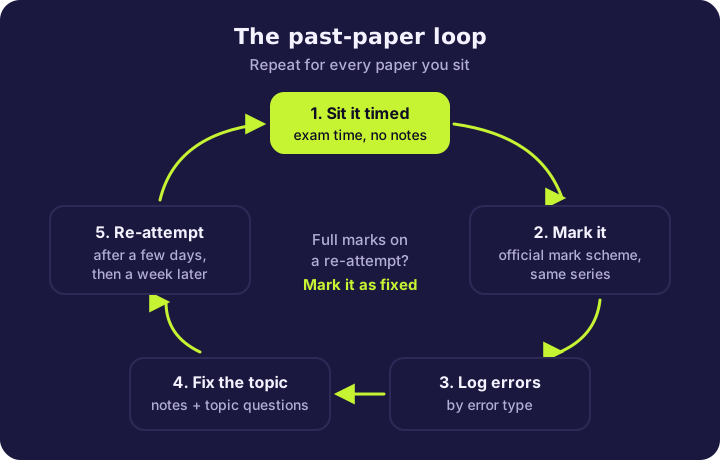
- Pick one Paper 4 (or Paper 3) question, not a whole paper. Give yourself about one minute per mark.
- Mark it strictly with the official mark scheme. If your words do not match a marking point, no mark.
- Rewrite any answer that lost marks, then add the missing point to your list of phrases.
- Once a week, do a full paper in 1 hour 15 minutes to build speed.
For a full plan, read our guide on how to use IGCSE past papers with a 6-week revision plan. The same “show every step” habit wins marks in Maths too, as our list of common IGCSE Maths 0580 mistakes shows. If you are still choosing a board, compare Cambridge and Edexcel IGCSE first.
Key points
- IGCSE Chemistry Paper 4 is 1 hour 15 minutes, 80 marks and 50% of your result (syllabus for 2026–2028, unchanged for 2029).
- Count the marks in brackets and give at least that many separate, correct points.
- “Explain” needs a reason. Use collision theory words: particles, collisions, frequency, activation energy.
- In calculations, show every step, give units, use 24 000 for cm³, and round only at the end.
- Learn chemical tests exactly: reagent, order and observation. Paper 4 gives you no notes.
- Write balanced equations, with state symbols when asked, and avoid “it” and “they”.
- Grade thresholds change every series. In June 2026, an A on component 42 needed 53 out of 80.
Frequently asked questions
How long is IGCSE Chemistry Paper 4?
Paper 4 (Theory, Extended) of Cambridge IGCSE Chemistry 0620 lasts 1 hour 15 minutes and is out of 80 marks. That is just under one minute per mark. It is worth 50% of your final grade. The same timing and marks apply in the syllabus for 2026 to 2028 and in the published syllabus for 2029.
How many marks do you need for an A on 0620 Paper 4?
It changes every series. In June 2026, Cambridge's threshold table set grade A on component 42 at 53 out of 80, and grade C at 26. Other variants (41, 43) and other series have different numbers. Your final grade comes from your weighted total across all three papers, so check the threshold table for your own series.
What is the difference between describe and explain in IGCSE Chemistry?
Describe asks what happens: you state the main points or features. Explain asks why or how it happens: you give reasons and make the link between cause and effect clear. In rate questions, for example, describing says the reaction is faster, while explaining uses particles, collision frequency and activation energy to say why it is faster.
Do you get marks for working in IGCSE Chemistry calculations?
Yes, very often. Multi-step calculations on Paper 4 usually have marks for method as well as for the final answer, and examiners can carry an earlier error forward if the later steps are correct. If you write only a final number and it is wrong, there is nothing left to credit. Show each step on its own line.
How much should you write for a 3-mark question?
Write three separate, correct points, one for each mark. The answer lines on the paper are a guide to length, not a target to fill. Short, precise sentences that use the right chemical words score better than a long paragraph that repeats the same idea. If you finish a [3] answer with only two ideas, add the missing link.
What is the difference between Paper 3 and Paper 4 in IGCSE Chemistry?
Both are 1 hour 15 minute theory papers worth 80 marks and 50% of the grade. Paper 3 is for Core candidates and tests Core content only, with grades C to G available. Paper 4 is for Extended candidates, tests Core and Supplement content, and gives access to grades A* to G. Your school decides which you are entered for.
About this guide
Written by the Revizona team for IGCSE students in Indonesia. Exam facts are checked against the official Cambridge International and Pearson Edexcel documents for the current syllabus years, and the guide is updated when they change.