On this page
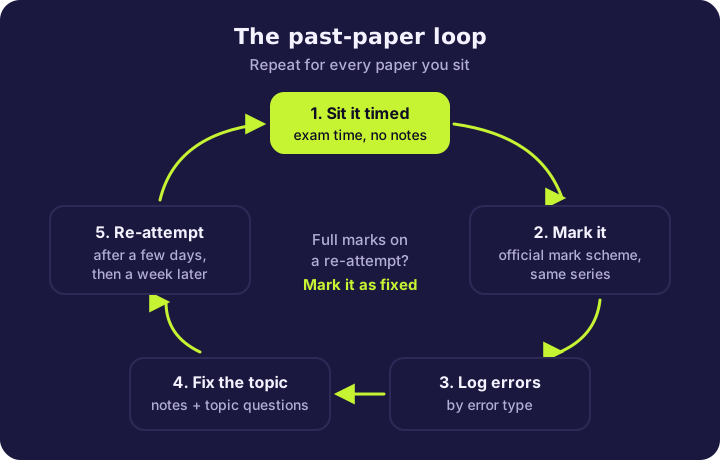
To use IGCSE past papers well, sit them under timed conditions, mark them strictly with the official mark scheme, log every lost mark, fix the topic behind it, and re-attempt the question a few days later. Start with topic questions, move to full papers in the last six weeks, and save the most recent papers for the end. This guide shows how to use IGCSE past papers for both Cambridge and Pearson Edexcel, step by step.
What IGCSE past papers are
An IGCSE past paper is a real exam paper from an earlier series, such as June or November, published by Cambridge or Pearson Edexcel. Each paper comes with a mark scheme that shows how examiners awarded marks, and usually an examiner report that explains where candidates lost marks. Used together, these three documents show you exactly what the exam rewards.
Why past papers work
Doing a past paper is a form of practice testing: you pull answers out of your memory instead of reading them again. In a large review of study techniques, Dunlosky and colleagues rated practice testing and spaced-out practice as the two most useful methods they studied, while re-reading and highlighting scored low (Dunlosky et al., 2013, Psychological Science in the Public Interest, 14(1)).
Past papers also make the exam itself familiar. You learn how questions are worded, how many points a 3-mark “explain” question needs, and how fast you have to work. On exam day, nothing should feel new except the questions.
But past papers only work if you mark them honestly and act on what you find.
Where to get past papers legally
Cambridge International (IGCSE)
- Your school. Registered Cambridge schools can download past papers, mark schemes and examiner reports from Cambridge’s password-protected School Support Hub. This is the fullest source, so ask your teacher or exams officer first. Schools can also get extra materials such as specimen paper answers and example candidate responses.
- The Cambridge website. Each syllabus page on cambridgeinternational.org has a free selection of past and specimen papers with mark schemes and examiner reports. Search for your subject and syllabus code (for example “0620” for Chemistry), then open the past papers section.
Pearson Edexcel (International GCSE)
- Pearson’s past paper search on qualifications.pearson.com lets you filter by qualification, subject and exam series. Students can download a large library of papers and mark schemes for free.
- The newest papers show a padlock. Pearson keeps them for teachers at registered schools so there is always an unseen paper for mock exams (Pearson: past papers for students). If your school has them, ask your teacher.
Avoid sites offering “leaked” or unofficial papers. They are not legal, and their answers are often wrong. Stick to the official papers and official mark schemes.
Check the paper matches your syllabus
Syllabuses change. Every Cambridge syllabus has a “Changes to this syllabus” section, and the current Cambridge IGCSE Chemistry 0620 syllabus covers exams in 2026, 2027 and 2028. Before using an older paper, check whether any topics or papers have been added or removed since it was set. If they have, skip questions on removed content and use the specimen paper to practise anything new.
How to use IGCSE past papers: the 5-step loop
Step 1: Topic questions first, full papers later
Early in your revision, work by topic. Pick one topic you have just revised, then find questions on it from several different past papers. This builds knowledge and shows you every way that topic can be asked. Mixing in questions from two or three topics in one session also helps, because the real paper switches topic without warning.
Once you have covered most of the syllabus, switch to full papers. These test timing, focus and switching quickly between topics.
Step 2: Sit full papers under timed conditions
Use the exact time printed on the front of the paper. Put your phone in another room and do not look at notes. Work out your pace before you start: divide the minutes by the total marks. For example, a paper with 90 minutes for 90 marks gives you about one minute per mark, so a 4-mark question should take about four minutes.
If you run out of time, draw a line, then finish the paper in a different colour pen. You will mark both parts, but only the first part counts as your score.
Step 3: Mark with the official mark scheme
Always use the mark scheme for the same paper, series and variant. Read the notes at the front first, because they explain the codes the examiners use. These codes are similar on both boards, but they vary by subject, so check each list.
Codes you will often see in maths and science mark schemes:
| Code | Meaning |
|---|---|
| M1 | Method mark: for a correct method, even if the final answer is wrong |
| A1 | Accuracy mark: for a correct answer; usually needs the method mark first |
| B1 | Independent mark: awarded on its own, not linked to a method mark |
| ft / ecf | Follow through / error carried forward: a wrong earlier answer used correctly later can still score |
| cao | Correct answer only |
| oe | Or equivalent: an equivalent answer is accepted |
| isw | Ignore subsequent working |
| owtte | “Or words to that effect”: different wording with the same meaning is accepted (Cambridge) |
| ignore | This part of an answer is not penalised, but it does not score either (Cambridge) |
Here is an original example to show how this works.
Question (3 marks): A shop reduces the price of a bag from $40 to $34. Work out the percentage decrease.
| Mark | What earns it |
|---|---|
| M1 | 40 − 34 = 6 seen, or 34 ÷ 40 = 0.85 seen |
| M1 | 6 ÷ 40 × 100, or (1 − 0.85) × 100 |
| A1 | 15 (cao) |
Weak answer · 1/3
40 − 34 = 6, then 6 ÷ 34 × 100 = 17.6%
Gets the first M1 for finding the 6, but loses the second M1 and the A1 for dividing by the new price.
Full-mark answer · 3/3
40 − 34 = 6, then 6 ÷ 40 × 100 = 15%
Correct difference, divided by the original price, correct final answer.
That one line tells the student exactly what to fix: percentage change is always divided by the original value. For more errors like this, see our list of Maths 0580 mistakes that cost the most marks.
In science, mark schemes often list several accepted points, separated by a slash. Your wording does not need to match exactly if the meaning is the same, but key technical words usually must be there. Our guide to answering longer Chemistry 0620 questions goes into this in detail.
Know the list rule. Cambridge science mark schemes explain how examiners treat questions that ask for a set number of answers, such as “give two reasons” (example: Physics 0625 mark scheme, June 2023). A wrong answer still uses up one of your places, and an answer that contradicts a correct one cancels it. So write your strongest points first, and do not add extra guesses.
Step 4: Keep an error log
Every mark you lose goes into a simple table: paper and question, topic, what you wrote, what the mark scheme wanted, and the type of error. The type matters most, because each type needs a different fix.
| Error type | What it looks like | How to fix it |
|---|---|---|
| Knowledge gap | You did not know the content | Re-learn the topic from notes, then do 3–5 topic questions on it |
| Misread | You answered a different question | Underline the command word and key data before writing |
| Method | You knew the idea but used the wrong steps | Write out the correct method once, then repeat it on a similar question |
| Careless | Units, rounding, copying a number wrong | Add a 2-minute check at the end of every paper |
| Exam technique | Too few points for the marks, or ran out of time | Match points to marks; practise pacing per mark |
After a few papers, patterns appear. If you keep misreading questions, more content revision will not help; reading the question twice will.
Step 5: Re-attempt wrong questions after a gap
Do not just read the correct answer and move on. Cover the answer and try the question again a few days later, then again a week or so after that. If you get full marks without help, mark it as fixed in your error log. This spacing is what moves knowledge into long-term memory, and it is the step most students skip.
How many past papers should you do?
There is no official number, and doing more papers is not the goal. One paper that is properly marked, logged and re-attempted teaches you more than three papers you never check.
In the 6-week plan below, you would sit about four or five full timed papers per subject, plus topic questions on weak areas. That is realistic alongside school. If you have more time, start topic questions earlier rather than squeezing in more full papers at the end. A good sign you have done enough is when your error log stops showing new types of mistake.
Which papers to do first
Work from older to newer. Use older papers for topic questions and your first full papers, and save the most recent two or three series for weeks 5 and 6. That way, your final mocks use papers you have never seen, which is the closest thing to the real exam.
If your school sets mock exams, ask which papers they will use, so you do not practise on them in advance.
A 6-week past paper revision plan
This plan assumes school during the day, so it uses short weekday sessions (about 45–60 minutes) and one longer weekend session. If you take many subjects, sit full papers for your three or four most important subjects each week and rotate the others.
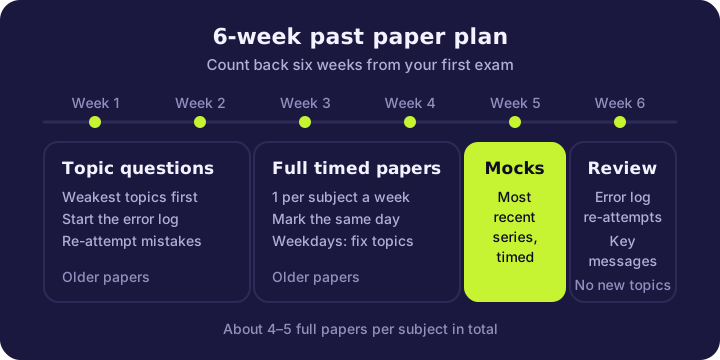
| Week | Sessions | What to do |
|---|---|---|
| 1 | 4 weekday + 1 weekend | Collect papers and mark schemes for each subject. Topic questions on your weakest topics. Start your error log. |
| 2 | 4 weekday + 1 weekend | More topic questions. Re-attempt week 1 mistakes. Read one examiner report per subject. |
| 3 | 3 weekday + 1 weekend | First full paper per subject, timed, at the weekend. Mark it the same day. Weekdays: fix the topics it exposed. |
| 4 | 3 weekday + 1 weekend | Second full paper per subject. Compare error types with week 3. Re-attempt all logged questions from weeks 1–2. |
| 5 | 3 weekday + 1 weekend | Full papers from the most recent series you can get. Practise timing on your slowest question types. |
| 6 | 3 weekday + 1 short weekend | No new topics. Re-attempt your error log, read examiner report “key messages” again, and rest before exams. |
If you are at a Cambridge school in Indonesia, you will sit your exams in the June or November series; Cambridge’s March series is only for schools in India. Pearson Edexcel International GCSE has a May/June series and a November series for some subjects, which replaced the old January series from 2023. Ask your school which series you are sitting, then count six weeks back from your first paper.
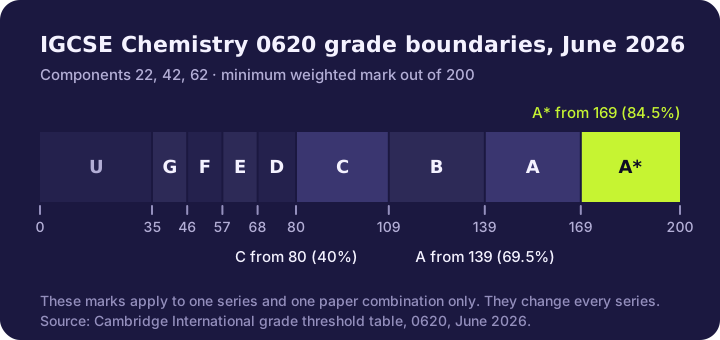
To understand what your marks mean as grades, read how grade boundaries work. Boundaries change every series, so use them as a rough guide, not a target.
How to use examiner reports
Both boards publish a report after each series. Cambridge reports are often titled Principal Examiner Report for Teachers, and Pearson publishes an Examiners’ Report for each paper. You will find them next to the past papers in the places described above.
A Cambridge report usually starts with key messages and general comments, then comments on each question, including common errors. Pearson’s reports also go through each question.
To use a report well:
- Sit and mark the paper first, then read the report for that same paper.
- For each question you lost marks on, read the examiner’s comments and copy useful advice into your error log.
- Before the exam, read the key messages from several recent reports for each subject. The same advice comes up again and again: read the question carefully, show your working, give units, and use precise technical words.
Common mistakes with past papers
- Doing many papers without marking them. The marking is where you learn.
- Looking at the mark scheme too early. If you check halfway through, you are no longer testing yourself. Finish the paper or section first.
- Being too generous with yourself. If the mark scheme needs a specific word and you did not write it, you did not get the mark.
- Only practising your favourite subject or topic. Your error log should guide what you practise, not what feels comfortable.
- Using the wrong syllabus or board. A Cambridge mark scheme will not tell you how Edexcel marks, and an old paper may test content that has since been removed. If you are unsure which board you are taking, see Cambridge vs Edexcel IGCSE compared.
- Ignoring examiner reports. They show, question by question, where real candidates lost marks.
Key points
- Practice testing is one of the best-supported ways to revise, but only if you mark your work.
- Get papers from your school (Cambridge School Support Hub), the Cambridge syllabus pages, or Pearson’s past paper search.
- Check each paper matches your current syllabus.
- Start with topic questions, then move to full timed papers.
- Mark with the official mark scheme and learn what M1, A1, B1 and the other codes mean.
- Log every lost mark by error type, fix it, and re-attempt it after a gap.
- Aim for papers you learn from, not a fixed number; about four or five full papers per subject fits a 6-week plan.
- Save the most recent papers for the final two weeks.
Frequently asked questions
How many past papers should I do for IGCSE?
There is no official number. What matters is how many you mark and learn from. In a 6-week plan, four or five full timed papers per subject, plus topic questions on your weak areas, is realistic alongside school. A good sign you have done enough is when your error log stops showing new types of mistake and your re-attempts score full marks.
When should I start doing IGCSE past papers?
Start with topic questions from past papers as soon as you finish teaching a topic in class, even months before the exam. Move to full timed papers once you have covered most of the syllabus, usually in the last six to eight weeks. Starting full papers too early just shows you topics you have not learned yet.
Where can I download IGCSE past papers for free?
For Cambridge, each syllabus page on cambridgeinternational.org has a free selection of past and specimen papers, and your school can download more from the School Support Hub. For Edexcel International GCSE, Pearson's past paper search on qualifications.pearson.com is free for students, except the most recent papers, which only registered schools can open.
Are IGCSE past paper questions repeated?
Exact questions are not repeated, but the same skills and topics come up again and again, often with similar wording and mark allocations. That is why past papers are useful. Syllabuses do change, though, so check the list of changes in the syllabus for your exam year before trusting an older paper.
Is it better to do past papers or revise from notes?
You need both, in that order. Notes give you the content; past papers test whether you can recall and use it under exam conditions. Research rates practice testing far higher than re-reading. A good balance is to learn a topic from notes, then test it with past-paper questions the same week.
Should I do old or recent past papers first?
Do older papers first and save the most recent two or three series for the final weeks, so you have fresh papers for full mock exams. Before using an old paper, check it was written for your current syllabus. If the syllabus has changed, use the specimen paper as well.
About this guide
Written by the Revizona team for IGCSE students in Indonesia. Exam facts are checked against the official Cambridge International and Pearson Edexcel documents for the current syllabus years, and the guide is updated when they change.