On this page
- What is an IGCSE grade boundary?
- How IGCSE grade boundaries are set and why they change
- How Cambridge IGCSE grade thresholds work
- How Edexcel International GCSE grade boundaries work
- Tiers: the highest grade you can get
- What percentage is an A* in IGCSE?
- How to estimate your grade from a past paper
- When grade boundaries are published, and what to do if you just miss one
- Key points
IGCSE grade boundaries are the minimum marks needed for each grade, and they are set again after every exam series. There is no fixed percentage for an A* or a 9. In June 2026, for example, an A* in Cambridge Chemistry 0620 needed between 84% and 87.5% (168 to 175 out of 200) depending on the papers sat, while a grade 9 in Edexcel Maths A needed 82.5% or 85.5%.
This guide shows you how boundaries are set, how to read the official tables, and how to turn a past-paper score into an honest grade estimate. It covers both Cambridge IGCSE and Pearson Edexcel International GCSE.
What is an IGCSE grade boundary?
An IGCSE grade boundary (Cambridge calls it a grade threshold) is the lowest total mark that earns a particular grade in a particular exam series. If the A boundary is 139, then 139 is an A and 138 is a B. Boundaries are decided after marking, so the mark needed for the same grade changes every series.
Cambridge states it plainly: “Grade thresholds are only set after a question paper has been sat and marked” (Cambridge help centre). That is why nobody, including your teacher, can tell you next summer’s boundaries in advance.
How IGCSE grade boundaries are set and why they change
Both boards aim to keep each grade worth the same from year to year. Papers are never exactly equal in difficulty, so the number of marks has to move instead.
- Harder paper: the same quality of work earns fewer marks, so boundaries go down.
- Easier paper: the same work earns more marks, so boundaries go up.
Cambridge says that when it sets thresholds it looks at evidence such as schools’ forecast grades and how different groups of candidates performed. The marks needed for a grade may change, but the standard does not.
Pearson uses statistical evidence, including how schools’ students did in the past, to carry the standard forward at three key grades: 7, 4 and 1. Senior examiners then look at real student work at those marks to check it is the right quality.
Tip: a lower boundary does not mean the exam was “easier to pass”. It usually means the paper was harder, so everyone scored lower.
How Cambridge IGCSE grade thresholds work
Cambridge publishes a grade threshold table for each syllabus after each series. Chemistry 0620, for example, is examined in June and November (and in March for schools in India only), so a new table appears after each of those series.
Each table has two parts: component thresholds and syllabus thresholds.
Component thresholds and paper versions
A component is one paper. The first part of the table shows the raw mark (your actual score on that paper) needed for each grade. There is no A* at component level, because A* only exists for the whole subject.
You will see codes such as 21, 22 and 23. The first digit is the paper number. The second digit is the version: Cambridge writes different versions of the same paper for different parts of the world, for exam security. So 21, 22 and 23 are all Paper 2, and each version gets its own thresholds. Your school can tell you which version you sat.
Cambridge’s guide to converting component marks into syllabus grades is clear that component grades are not used to work out your final grade. They are only a guide to how you did on each paper.
Syllabus thresholds and weighted marks
Your final grade does not come from adding raw marks. Each paper is multiplied by a weighting factor, the results are added into one weighted total, and that total is compared with the syllabus thresholds for your exact combination of papers. If the total ends in .5, Cambridge rounds it up.
Older tables label each combination with a two-letter “option” code (for example, the June 2024 Chemistry table used CY for components 22, 42 and 62). Newer tables simply list the components. Either way, find the row with the exact papers you sat.
A real example: Chemistry 0620, June 2026
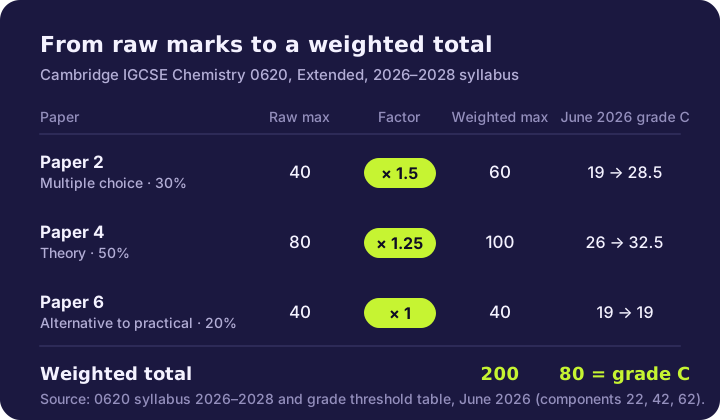
The Cambridge IGCSE Chemistry 0620 syllabus for 2026–2028 says Extended candidates take Paper 2 (multiple choice, 40 marks, 30%), Paper 4 (theory, 80 marks, 50%) and either Paper 5 (practical test) or Paper 6 (alternative to practical), each 40 marks and 20%.
The June 2026 grade threshold table for 0620 gives a maximum weighted mark of 200. So the weightings work out like this:
| Paper | Raw max | Weighting | Weighted max | Multiply raw mark by |
|---|---|---|---|---|
| Paper 2 (component 22) | 40 | 30% | 60 | 1.5 |
| Paper 4 (component 42) | 80 | 50% | 100 | 1.25 |
| Paper 6 (component 62) | 40 | 20% | 40 | 1 |
| Total | 100% | 200 |
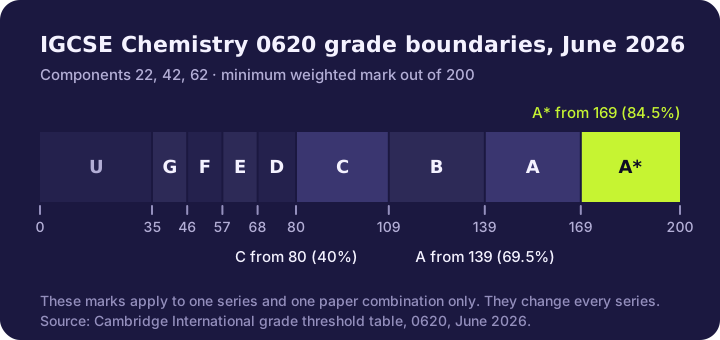
For the combination 22, 42, 62 in June 2026, the syllabus thresholds were:
| Grade | A* | A | B | C | D | E | F | G |
|---|---|---|---|---|---|---|---|---|
| Minimum weighted mark (out of 200) | 169 | 139 | 109 | 80 | 68 | 57 | 46 | 35 |
You can check how the syllabus row connects to the component rows. The grade C thresholds were 19 on component 22, 26 on component 42 and 19 on component 62. Weighted, that is 19 × 1.5 + 26 × 1.25 + 19 × 1 = 80, exactly the syllabus C threshold.
Same subject, same series, different boundaries
Here is what changes when the only difference is the paper version. All three rows are Extended Chemistry 0620 with the alternative to practical, from the same June 2026 table.
| Components | A* | A | C |
|---|---|---|---|
| 21, 41, 61 | 175 (87.5%) | 150 (75%) | 93 (46.5%) |
| 22, 42, 62 | 169 (84.5%) | 139 (69.5%) | 80 (40%) |
| 23, 43, 63 | 172 (86%) | 145 (72.5%) | 90 (45%) |
A score of 145 out of 200 was an A on versions 22 and 23, but a B on version 21. Nobody was treated unfairly: each set of thresholds reflects how demanding that version turned out to be. This is why you should never borrow a boundary from a different version of the paper.
If you want to pick up more marks inside these papers, read our guide on answering longer Chemistry 0620 questions.
How Edexcel International GCSE grade boundaries work
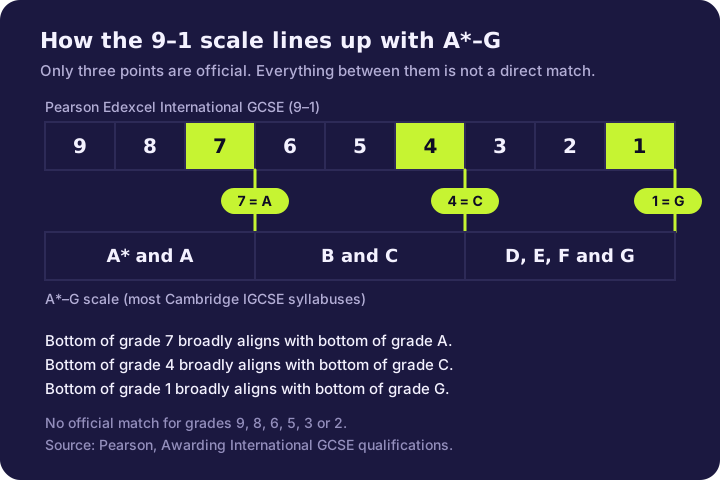
Pearson Edexcel International GCSE uses the 9–1 scale, where 9 is the highest grade. The Mathematics A (4MA1) specification states that the qualification is graded on the total subject mark and that individual papers are not graded.
So for Edexcel, the boundary that matters is the overall one. Pearson’s grade boundary documents give the maximum mark and the raw-mark boundary for each grade for the whole qualification. Pearson also publishes notional component boundaries, but it says these are for information only and do not equal a grade.
A real example: Maths A 4MA1, June 2026
The Pearson International GCSE grade boundaries for June 2026 list two Higher tier rows for Maths A, one for papers 1H and 2H and one for papers 1HR and 2HR. Both are out of 200.
| Higher tier papers | 9 | 8 | 7 | 6 | 5 | 4 | 3 |
|---|---|---|---|---|---|---|---|
| 1H, 2H | 165 | 138 | 111 | 87 | 64 | 41 | 29 |
| 1HR, 2HR | 171 | 145 | 119 | 94 | 69 | 45 | 33 |
So a 9 needed 82.5% on one set and 85.5% on the other, and a grade 4 needed only about a fifth of the marks. As with Cambridge, check which set of papers your school sat before you use a row.
How grade 9 is set
Pearson sets grade 9 in International GCSE in the same way as for UK GCSE (9–1). Grade 9 is designed to reward the very highest performance, and Pearson describes it as a new level of attainment. Like every boundary, it is only fixed after the results are in, so never assume a 9 sits at a set percentage.
Cambridge 9–1 syllabuses: some Cambridge IGCSE subjects are also offered graded 9–1, with their own syllabus codes (for example English First Language 9–1 is 0990). They have their own threshold tables, so do not mix them with the A*–G tables.
Tiers: the highest grade you can get
Some subjects have two levels of paper. The level you are entered for limits your top grade, whatever your score.
| Board | Lower tier | Highest grade | Higher tier | Grades available |
|---|---|---|---|---|
| Cambridge IGCSE (e.g. 0620) | Core | C | Extended | A* to G |
| Edexcel International GCSE (e.g. Maths A 4MA1) | Foundation | 5 | Higher | 9 to 4, grade 3 allowed |
The 0620 syllabus says Core candidates can get grades C to G. The 4MA1 specification says Foundation gives grades 5 to 1, and Higher gives 9 to 4 with grade 3 allowed. On Higher, a score below the grade 3 boundary is a U, so Higher is a risk if your scores are weak. Tier rules differ between subjects, so check your own syllabus. Our Cambridge vs Edexcel IGCSE comparison explains the other differences between the boards.
What percentage is an A* in IGCSE?
Ignore any website that gives one fixed percentage. The tables above show A* and grade 9 boundaries between about 82% and 88% in two subjects in a single series, and the figures move again next series. A better question is: “What has been enough for an A* in my subject, on my papers, recently?” You can answer that yourself.
Set a target from the last three series
- Download the threshold or boundary tables for your subject from the last three series. For Cambridge, find the row with your exact paper combination.
- Write down the boundary for your target grade in each series, as a percentage of the maximum mark.
- Take the highest of the three, not the average. That is your minimum target.
- Add a safety margin of a few marks. You cannot know which way the next boundary will move.
How to estimate your grade from a past paper
Here is a Cambridge example, using example scores (not a real student). Say you sat a full Extended Chemistry set at home and scored 33/40 on Paper 2, 62/80 on Paper 4 and 30/40 on Paper 6, using the June 2026 papers 22, 42 and 62.
Wrong method
Add the raw marks: 33 + 62 + 30 = 125. Compare 125 with the syllabus thresholds: it is above B (109) and below A (139), so “a B”.
This is wrong because the raw total is out of 160, while the thresholds are weighted marks out of 200.
Right method
Weight each paper first, then add:
- Paper 2: 33 × 1.5 = 49.5
- Paper 4: 62 × 1.25 = 77.5
- Paper 6: 30 × 1 = 30
- Weighted total: 157 out of 200
157 is above A (139) and below A* (169): a secure A, 12 marks short of an A*.
For Edexcel, it is simpler. Add your paper totals and compare the sum with the overall boundaries for the same series and the same set of papers. For example, 70 on 1H and 68 on 2H from June 2026 gives 138, which sits exactly on the grade 8 boundary.
Three rules keep the estimate honest:
- Use the boundaries from the same series and version as the paper. A June 2025 paper should be checked against June 2025 boundaries, because the boundary reflects how hard that paper was.
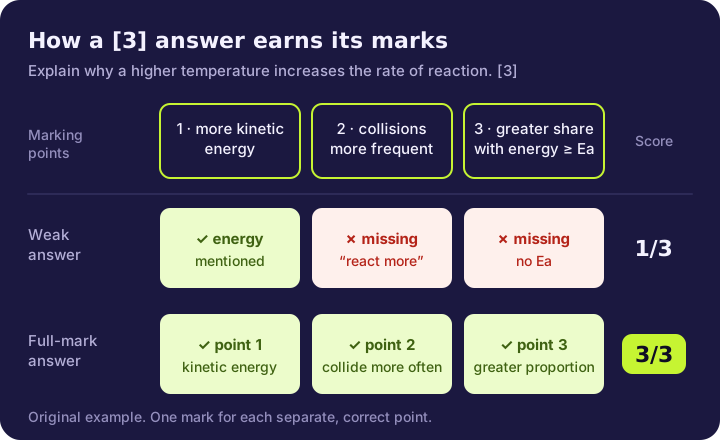
- Mark strictly. Use the official mark scheme and do not give yourself “nearly” marks. A generous mark makes the whole estimate wrong.
- Look at a range, not one paper. One score can be lucky. Three or four recent papers give a far more reliable picture.
Watch out: if your total is within a few marks of a boundary, treat it as either grade. A single careless slip can move you across the line.
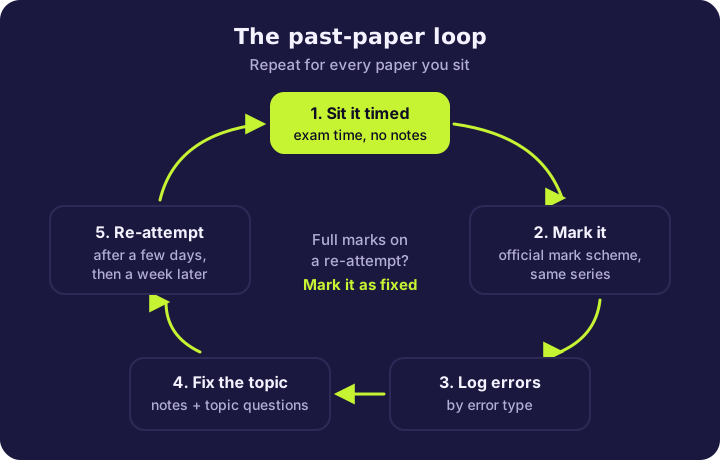
Our guide to using IGCSE past papers shows how to fit this into a six-week revision plan. If you take Maths, check the Maths 0580 mistakes that cost the most marks, because careless marks often decide which side of a boundary you land.
When grade boundaries are published, and what to do if you just miss one
Neither board publishes boundaries before an exam. Cambridge threshold tables and Pearson boundary documents appear on their websites after each series is marked and graded. For the November 2026 series, Cambridge IGCSE results are released on 14 January 2027.
If you end up one or two marks below a boundary, talk to your school’s exams officer. Cambridge offers a review of marking (an “enquiry about results”) that only your school can request, and Pearson has its own post-results services. Cambridge is clear that a review can move your mark, and your grade, down as well as up. Your school will know the deadlines and any fees.
Key points
- Grade boundaries are set after each exam is marked, based on how hard the paper was. They change every series and can go up or down.
- Cambridge: each paper’s raw mark is weighted, the weighted marks are added, and the total is compared with the thresholds for your exact combination of components.
- Paper versions matter: in June 2026 Chemistry 0620, A* needed anywhere from 168 to 175 out of 200 depending on the versions sat.
- Edexcel International GCSE: your grade comes from your total across all papers. Grade 9 uses the same method as UK GCSE (9–1).
- Tier matters: Cambridge Core tops out at C, and Edexcel Foundation (for example in Maths A) tops out at 5.
- There is no fixed percentage for an A* or a 9. Use the highest boundary from the last three series plus a margin as your target.
- To estimate a grade, mark strictly, weight correctly, and compare with the boundaries for the same series and version.
Frequently asked questions
What percentage is an A* in IGCSE?
There is no fixed percentage. The A* boundary is set after every series and differs by subject and paper version. In June 2026, Cambridge Chemistry 0620 needed 169 out of 200 (84.5%) on components 22, 42 and 62, but 175 (87.5%) on components 21, 41 and 61. Use the official threshold table for your exact papers.
Is 70% an A in IGCSE?
Sometimes, but not always. In June 2026 Cambridge Chemistry 0620, 70% (140 out of 200) was just above the A threshold of 139 on components 22, 42 and 62. On components 21, 41 and 61 the A threshold was 150, so the same 140 would have been a B. Always check the boundary for your own papers.
When are IGCSE grade boundaries released?
Only after the exams have been sat and marked, so never in advance. Cambridge publishes a grade threshold table for each syllabus after each series, and Pearson publishes International GCSE grade boundary documents for each series on its website. For the November 2026 series, Cambridge IGCSE results are released on 14 January 2027.
Can IGCSE grade boundaries go down?
Yes. Boundaries move in both directions. If a paper turns out harder than usual, the same quality of work earns fewer marks, so the boundary goes down. If a paper is easier, it goes up. The standard for each grade stays the same; only the number of marks needed to reach it changes from series to series.
Are grade boundaries the same for all paper variants?
No. Cambridge sets different versions of a paper (for example components 21, 22 and 23) for different regions, and each version can have its own thresholds. In June 2026 Chemistry 0620, the A* threshold ranged from 168 to 175 out of 200 depending on the combination of papers. Pearson also lists separate boundaries for its two sets of papers.
About this guide
Written by the Revizona team for IGCSE students in Indonesia. Exam facts are checked against the official Cambridge International and Pearson Edexcel documents for the current syllabus years, and the guide is updated when they change.