On this page
- Cambridge vs Edexcel IGCSE at a glance
- What is the difference between Cambridge and Edexcel IGCSE?
- Grading: A*–G letters vs 9–1 numbers
- Exam series: June and November (no January for Edexcel)
- Tiers: Core/Extended vs Foundation/Higher
- Chemistry, Maths and Physics: paper by paper
- Time pressure: minutes per mark
- Comparing your scores across boards
- How to tell which syllabus you are on
- Can you switch boards?
- Which is easier: Cambridge or Edexcel IGCSE?
- Key points
Cambridge vs Edexcel IGCSE: neither board is officially easier. Both are designed at UK GCSE level. The real differences are the grading scale (A*–G for most Cambridge syllabuses, 9–1 for Edexcel), the exam series, how tiers work, and how the papers are built.
This guide compares them using the official Cambridge syllabuses for exams in 2026 and the current Pearson specifications. It is written for students and parents at international schools, including in Indonesia, who want facts rather than opinions.
Cambridge vs Edexcel IGCSE at a glance
| Cambridge IGCSE | Pearson Edexcel International GCSE | |
|---|---|---|
| Run by | Cambridge International Education | Pearson |
| Main grade scale | A*–G (separate 9–1 syllabuses exist) | 9–1 |
| Exam series (Chemistry, Maths, Physics) | June and November (March in India only) | May/June and November |
| January series | No | No (last one was January 2023) |
| Tiers in the sciences | Core or Extended | None: one set of papers for everyone |
| Tiers in Maths | Core or Extended | Foundation or Higher |
| Practical skills in the sciences | Separate paper (Practical Test or Alternative to Practical) | Tested inside the written papers |
| Calculator in Maths | One paper without, one paper with | Allowed in all papers |
| Coursework in these three subjects | None | None |
The rest of this post explains each row, with the paper-by-paper numbers.
What is the difference between Cambridge and Edexcel IGCSE?
Cambridge IGCSE and Pearson Edexcel International GCSE are two separate qualifications from two different exam boards, both designed for students aged about 14 to 16. They cover similar core content in most subjects. They differ in grading scale, exam series, tiers and paper structure, so past papers from one board are not a perfect match for the other.
Cambridge IGCSE is run by Cambridge International Education, part of Cambridge University Press & Assessment. It changed its name from Cambridge Assessment International Education in October 2023, so older documents may use the old name.
Pearson Edexcel International GCSE is run by Pearson. Notice that Pearson says “International GCSE”, not “IGCSE”. People often say “Edexcel IGCSE”, but use the official name on forms and applications.
On level, the Cambridge IGCSE Chemistry 0620 syllabus states that UK ENIC found Cambridge IGCSE comparable to the UK GCSE. The Pearson 4CH1 specification describes its content as equivalent in standard to Pearson’s regulated GCSE in Chemistry, while noting that the International GCSE itself is not regulated by a UK regulator.
Grading: A*–G letters vs 9–1 numbers
This is the difference most students notice first.
Cambridge IGCSE is usually graded A* to G. Cambridge also publishes separate Cambridge IGCSE (9–1) syllabuses with their own codes, such as Chemistry 0971, Mathematics 0980 and Physics 0972. You cannot take the A*–G and the 9–1 version of the same subject in the same exam series. Your school decides which version it enters you for.
Pearson Edexcel International GCSE is graded 9 to 1, where 9 is the highest. Below grade 1 is U (unclassified).
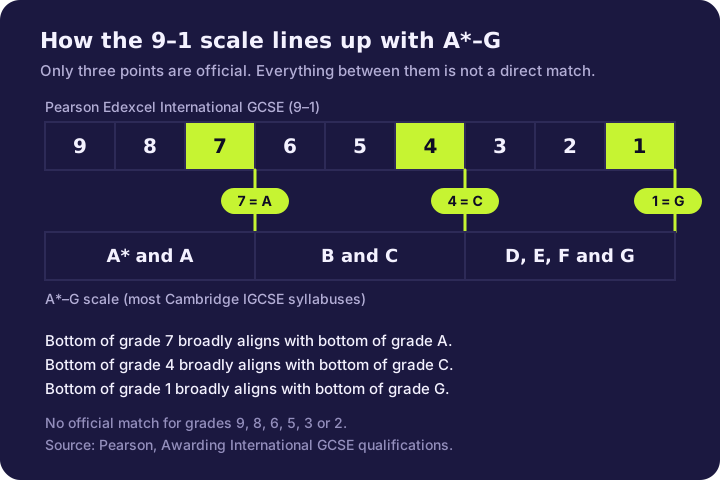
So how do numbers compare with letters? Pearson’s guide to awarding International GCSE qualifications gives three anchor points, shown in the diagram above:
| Pearson 9–1 | Broadly aligns with |
|---|---|
| Bottom of grade 7 | Bottom of grade A |
| Bottom of grade 4 | Bottom of grade C |
| Bottom of grade 1 | Bottom of grade G |
Pearson says grade 9 is “a new level of attainment”. It does not publish a match for 9, 8, 6, 5, 3 or 2. Many websites say “9 = A*” or “6 = B”. Those are estimates, not official mappings.
Grade boundaries for both boards change every series. Our guide to how IGCSE grade boundaries work explains why.
Exam series: June and November (no January for Edexcel)
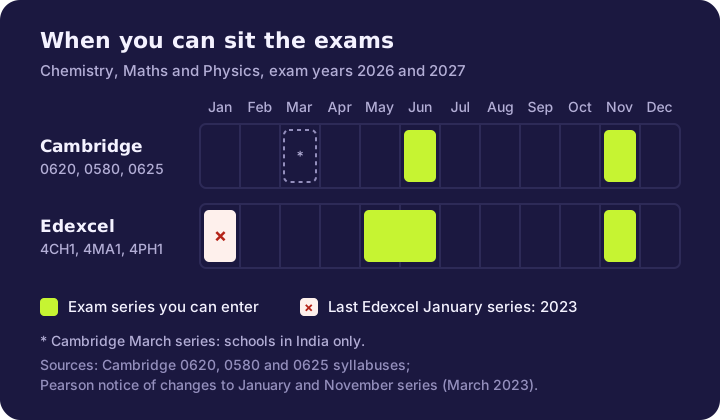
Cambridge IGCSE: Chemistry 0620, Mathematics 0580 and Physics 0625 are available in the June and November series. A March series exists, but only for schools in India. If you study in Jakarta, Surabaya or Bali, your Cambridge options are June or November.
Pearson Edexcel International GCSE: Pearson’s notice of changes confirms that Chemistry 4CH1, Mathematics A 4MA1 and Physics 4PH1 had their last January exams in 2023 and moved to a November series from November 2023. All International GCSEs are still offered in May/June.
Many guides are out of date. Several popular comparison pages still list a January series for Edexcel. It ended in January 2023. If you are planning a resit, look at Pearson’s own pages, not a tutoring blog.
Your school chooses which series it enters. Ask early if you are hoping for a November resit, because not every school offers both.
Tiers: Core/Extended vs Foundation/Higher
Both boards let students of different ability sit different papers in some subjects, but they work differently.
Cambridge uses Core and Extended in all three subjects. Core papers cover only the Core content, and the highest grade is C. Extended covers Core plus Supplement content and gives A* to G in Chemistry and Physics, or A* to E in Maths. The 0620 syllabus says Extended is for candidates expected to achieve grade C or above.
Edexcel uses Foundation and Higher tiers in Maths A only. Foundation gives grades 5 to 1. Higher gives 9 to 4, with grade 3 allowed if you just miss 4. Edexcel Chemistry and Physics are untiered: everyone sits the same two papers and can get any grade from 9 to 1.
Tip for Cambridge students: if you are aiming above a C, check that you are entered for Extended. Your statement of entry shows the paper numbers: Papers 2 and 4 are Extended, Papers 1 and 3 are Core.
Chemistry, Maths and Physics: paper by paper
These tables use the Cambridge syllabuses for exams in 2026 (Chemistry 0620 and Physics 0625: 2026–2028; Maths 0580: 2025–2027) and the current Pearson specifications for 4CH1, 4MA1 and 4PH1.
Chemistry: 0620 vs 4CH1
| Cambridge IGCSE Chemistry 0620 | Edexcel International GCSE Chemistry 4CH1 | |
|---|---|---|
| Tiers | Core or Extended | Untiered |
| Papers you sit | 3 | 2 |
| Paper details | Multiple choice, 45 min (40 marks, 30%); Theory, 1 h 15 min (80 marks, 50%); Practical Test 1 h 15 min or Alternative to Practical 1 h (40 marks, 20%) | Paper 1, 2 h (110 marks, 61.1%); Paper 2, 1 h 15 min (70 marks, 38.9%) |
| Total exam time | 3 h 15 min (with Paper 5) or 3 h (with Paper 6) | 3 h 15 min |
| Grades | A*–G (Extended), C–G (Core) | 9–1 |
Maths: 0580 vs 4MA1
| Cambridge IGCSE Mathematics 0580 | Edexcel International GCSE Mathematics A 4MA1 | |
|---|---|---|
| Tiers | Core or Extended | Foundation or Higher |
| Papers you sit | 2 | 2 |
| Paper details | Core: Paper 1 (non-calculator) and Paper 3 (calculator), 1 h 30 min and 80 marks each. Extended: Paper 2 (non-calculator) and Paper 4 (calculator), 2 h and 100 marks each. Each paper 50% | Two papers per tier, 2 h and 100 marks each, 50% each |
| Calculator | One non-calculator paper, one calculator paper | Allowed in all papers |
| Grades | A*–E (Extended), C–G (Core) | 9–4, with 3 allowed (Higher); 5–1 (Foundation) |
The calculator rule is one of the biggest practical differences. If fractions and mental arithmetic are weak spots, Cambridge’s non-calculator paper needs extra practice. Our post on the Maths 0580 mistakes that cost the most marks covers this in detail.
Physics: 0625 vs 4PH1
| Cambridge IGCSE Physics 0625 | Edexcel International GCSE Physics 4PH1 | |
|---|---|---|
| Tiers | Core or Extended | Untiered |
| Papers you sit | 3 | 2 |
| Paper details | Multiple choice, 45 min (40 marks, 30%); Theory, 1 h 15 min (80 marks, 50%); Practical Test 1 h 15 min or Alternative to Practical 1 h (40 marks, 20%) | Paper 1, 2 h (110 marks, 61.1%); Paper 2, 1 h 15 min (70 marks, 38.9%) |
| Total exam time | 3 h 15 min (with Paper 5) or 3 h (with Paper 6) | 3 h 15 min |
| Grades | A*–G (Extended), C–G (Core) | 9–1 |
In Edexcel Chemistry and Physics, Paper 1 tests the main content. Paper 2 tests all content, including the extra material marked in bold in the specification. Both papers mix multiple choice, short answers, calculations and longer written answers.
Practicals and coursework
Neither board uses coursework in these three subjects. The difference is how practical skills are tested.
- Cambridge Chemistry and Physics have a separate practical paper. Your school chooses Paper 5 (a Practical Test in a lab) or Paper 6 (Alternative to Practical, a written paper about experiments). Either way it is worth 20%.
- Edexcel Chemistry and Physics have no practical paper. Pearson’s specifications state that experimental skills are assessed through the written exams.
Time pressure: minutes per mark
No competitor guide we found does this, but it is one of the most useful ways to compare how the papers feel. Divide each paper’s time by its marks, using the official figures above.
| Paper | Time ÷ marks | About |
|---|---|---|
| Cambridge 0620/0625 Paper 2 (Extended multiple choice) | 45 min ÷ 40 | 1.1 min per mark |
| Cambridge 0620/0625 Paper 4 (Extended theory) | 75 min ÷ 80 | 0.9 min per mark |
| Cambridge 0620/0625 Paper 6 (Alternative to Practical) | 60 min ÷ 40 | 1.5 min per mark |
| Edexcel 4CH1/4PH1 Paper 1 | 120 min ÷ 110 | 1.1 min per mark |
| Edexcel 4CH1/4PH1 Paper 2 | 75 min ÷ 70 | 1.1 min per mark |
| Cambridge 0580 Paper 2 or 4 (Extended) | 120 min ÷ 100 | 1.2 min per mark |
| Edexcel 4MA1 any paper | 120 min ÷ 100 | 1.2 min per mark |
What this tells you:
- Cambridge Extended theory is the tightest paper in the sciences, at under a minute per mark. Practise it with a timer.
- Edexcel’s science papers have an even pace, but Paper 1 asks you to stay focused for two hours.
- Maths is the same pace on both boards. The real Maths difference is the calculator rule, not time.
Comparing your scores across boards
Students who use past papers from both boards often draw the wrong conclusion. Here is an original example.
Weak reasoning
“I scored 62% on a Cambridge Paper 4 and 70% on an Edexcel Paper 1, so Edexcel must be easier and I should switch.”
Strong reasoning
“Percentages from different papers cannot be compared. Grade boundaries are set separately for each board, syllabus and series. Also, Cambridge weights its papers: the multiple-choice paper is 40 of 160 raw marks (25%) in the Extended route but counts for 30% of the grade. Edexcel’s 180 marks are not scaled. I will check each score against that series’ official grade threshold table instead.”
For a step-by-step way to mark and track past papers, see how to use IGCSE past papers, with a 6-week plan.
How to tell which syllabus you are on
Syllabus codes matter more than board names. They appear on your statement of entry and on every past paper.
| Code | What it is |
|---|---|
| 0620, 0580, 0625 | Cambridge IGCSE Chemistry, Maths, Physics (A*–G) |
| 0971, 0980, 0972 | Cambridge IGCSE (9–1) Chemistry, Maths, Physics |
| 4CH1, 4MA1, 4PH1 | Edexcel International GCSE Chemistry, Maths A, Physics (linear, 9–1) |
| 4XCH1 | Edexcel International GCSE Chemistry, modular route |
Pearson’s modular Chemistry route (4XCH1) was first examined in June 2025. It has two unit exams of 1 h 40 min each, available in June and November. If your school mentions “units”, check whether you are on this route, because the paper structure above will not match.
Can you switch boards?
Your school decides which boards it offers, so switching usually means a school decision or entering as a private candidate. In Indonesia, the British Council Indonesia Foundation lists Cambridge IGCSE entries for private candidates; contact it for current series and deadlines.
If you do switch, three steps help:
- Compare the syllabuses topic by topic. Core topics overlap a lot, but each board has content the other does not. Use the official syllabus documents, not a summary.
- Learn the new paper style. Cambridge science students moving to Edexcel lose the separate multiple-choice and practical papers. Edexcel students moving to Cambridge must prepare for a practical paper and, in Maths, a non-calculator paper.
- Practise the new board’s past papers. Command words and mark schemes differ in detail. For Cambridge Chemistry, our guide to answering 0620 long-answer questions shows how marks are awarded.
Which is easier: Cambridge or Edexcel IGCSE?
Neither board is officially easier, and we know of no official source that ranks one above the other. A website that says “Edexcel is easier” is giving an opinion. Even some leading comparison pages say the boards are equal and then call one harder a few paragraphs later.
What is true is that they feel different:
- Paper style. Cambridge sciences split the exam into short, focused papers. Edexcel uses two longer mixed papers.
- Tier risk. In Cambridge sciences, a Core entry caps you at C. In Edexcel sciences there is no tier decision, but everyone faces the hardest questions.
- Calculator. Cambridge Maths has a non-calculator paper. Edexcel Maths A does not.
- Practical skills. Cambridge tests them in a separate paper. Edexcel tests them inside the written papers.
- Grades. Edexcel gives 9–1 by default. Cambridge mostly uses A*–G.
Key points
- Neither board is officially easier. Both are designed at UK GCSE level.
- Edexcel has no January series. The last was January 2023. Chemistry, Maths A and Physics run in May/June and November.
- Cambridge runs June and November for 0620, 0580 and 0625 (March in India only).
- Only three grade anchors are official: bottom of 7 ≈ bottom of A, 4 ≈ C, 1 ≈ G.
- Check your tier. Cambridge Core caps you at C; Edexcel sciences are untiered.
- Check your syllabus code, and read each university’s exact grade requirement.
- Never compare raw percentages across boards, papers or series.
Frequently asked questions
Is Edexcel IGCSE easier than Cambridge IGCSE?
No official source says one board is easier. Cambridge reports that UK ENIC found Cambridge IGCSE comparable to the UK GCSE, and Pearson describes its International GCSE content as equivalent in standard to its regulated GCSE. What differs is the style: Cambridge sciences use shorter separate papers and a practical paper, while Edexcel uses two longer mixed papers. Choose the style that suits you.
Does Edexcel International GCSE still have a January exam series?
No. Pearson's last January International GCSE series was in January 2023. From November 2023 it runs a regular November series instead, including Chemistry 4CH1, Mathematics A 4MA1 and Physics 4PH1. All International GCSEs are still offered in May/June. Many websites still list January, so always check Pearson's own pages before planning a resit.
Is a grade 7 the same as an A?
Not exactly. Pearson says the bottom of grade 7 broadly aligns with the bottom of grade A, the bottom of grade 4 with the bottom of grade C, and the bottom of grade 1 with the bottom of grade G. It gives no direct match for grades 9, 8, 6, 5, 3 or 2, so do not assume that 9 equals A*.
Do universities prefer Cambridge or Edexcel IGCSE?
Both boards present their qualifications as being at UK GCSE level, and we know of no official source showing a general preference. Universities and sixth forms set their own entry requirements, often written as a grade such as C, 4 or 5 in Maths and English. Read the exact wording for each course you are applying to, and ask admissions if you are unsure.
Can I switch from Cambridge to Edexcel IGCSE?
It depends on your school, because the school decides which boards and syllabuses it offers. The core topics in Chemistry, Maths and Physics overlap a lot, but some content, the paper structure and the grading scale differ. If you switch, compare the two syllabuses topic by topic, fill the gaps, and practise the new board's past papers under timed conditions.
Are IGCSE and International GCSE the same thing?
They are the same level but different brand names. Cambridge calls its qualification Cambridge IGCSE. Pearson calls its version the Pearson Edexcel International GCSE, although many people say Edexcel IGCSE. Use the official name and syllabus code on forms and applications, for example Cambridge IGCSE Chemistry 0620 or Edexcel International GCSE Chemistry 4CH1.
About this guide
Written by the Revizona team for IGCSE students in Indonesia. Exam facts are checked against the official Cambridge International and Pearson Edexcel documents for the current syllabus years, and the guide is updated when they change.